 Destination
 Tours
Tours Tailor-made tour
 Travel blog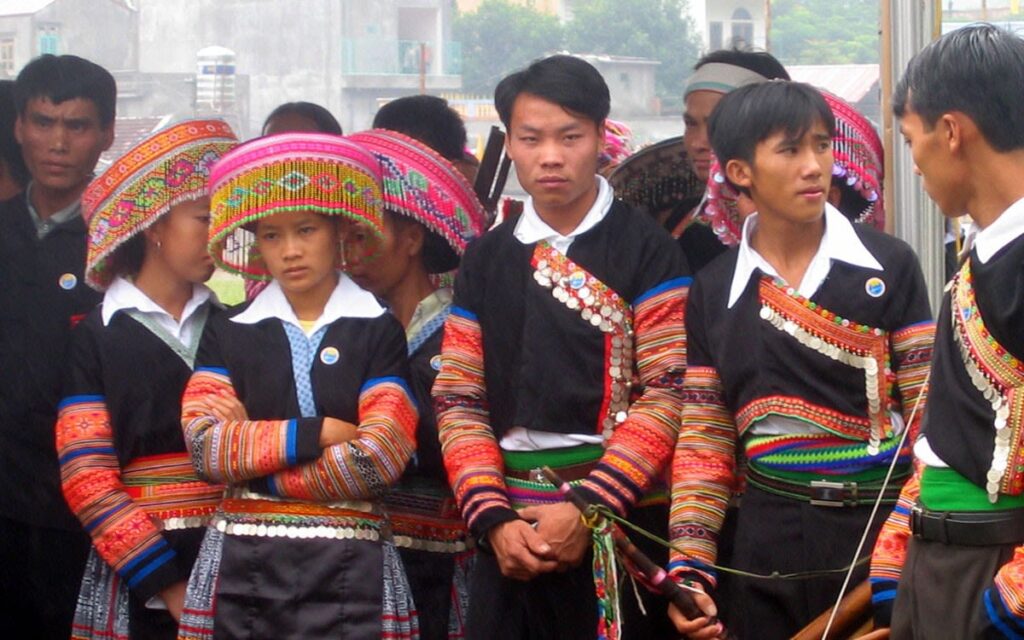
The H’mong are one of Vietnam’s ethnic minority groups, with a population of more than one million people. They are the fifth-largest ethnic group in the country. I have always had a great admiration for the H’mong, both because of their rich and distinctive culture and because I went to school with H’mong people when I was young and still have many H’mong friends today.
Vietnam Wild Ride’s motorcycle tours in northern Vietnam regularly pass through areas where H’mong communities live, so I wanted to write a short introduction to this resilient people and their history.

Most H’mong people in Vietnam live in the northern mountainous provinces of Ha Giang, Lao Cai, Lai Chau and Son La. There are several H’mong groups in Vietnam, commonly identified by names such as Flower H’mong, Green H’mong, Black H’mong and White H’mong. Although their traditional clothing and some local customs are different, they share a closely related language and many aspects of the same cultural heritage.
The H’mong migration into Vietnam took place in several major waves, beginning several centuries ago from areas that are now part of China. During the late Ming and early Qing periods, repeated conflicts and pressure from the Qing authorities contributed to large movements of H’mong communities southwards. Further migrations took place during the 18th and 19th centuries, often driven by conflict, political pressure and the search for safer places to live.

These migrations covered great distances. Many H’mong communities eventually moved from areas of present-day Guizhou, Guangxi and Yunnan into the mountains of Vietnam, Laos and other parts of mainland Southeast Asia.
Even after arriving in Vietnam, life was not always peaceful. In the northern borderlands, including the Dong Van area, H’mong communities lived through periods of conflict and political upheaval during the late 19th and early 20th centuries. They had to deal with competing powers, including the French colonial authorities and Chinese rebel groups crossing the border.
Despite such a difficult history, the H’mong have survived and maintained a strong sense of community. In the past, many H’mong families practised shifting cultivation and moved between different areas in search of land. Today, most communities live in permanent villages and mainly grow rice and corn and raise livestock.

The H’mong also became well known for growing opium during the colonial period. Opium was an important part of the colonial economy in the northern mountains and was traded through networks controlled or taxed by the French. Today, opium cultivation has largely disappeared from H’mong communities in Vietnam.
Because many H’mong communities live in remote mountainous areas, economic conditions remain difficult in some places. Traditional practices such as early marriage still exist in some communities, although they have become less common. Tourism and urbanisation have also changed traditional H’mong life, especially in popular destinations such as Sapa. These changes have brought both opportunities and challenges.
Despite all these changes, the H’mong continue to live closely connected to the mountains and forests. Many traditional customs, crafts and cultural practices are still part of everyday life, while their strong sense of community and mutual support remains an important part of H’mong society.

The H’mong have a fascinating culture and many traditional crafts that have been passed down through generations. We will share more about these traditions in another article.
Thank you for taking the time to read about the H’mong people.
